The Bespoke Guide to Sleep
Natural Latex vs. Innerspring Mattresses: Comparing Feel, Support, and Materials
One offers a buoyant, close-to-the-body response; the other brings the familiar lift of a spring system. Natural latex and innerspring mattresses can both make a compelling case for the bedroom, but the label alone tells only part of the story. Their feel, support, and temperature comfort depend on the details beneath the cover—and on the person sleeping there.
Published October 27, 2026
Choosing a mattress is an unusually intimate design decision. It must work with the architecture of the room, certainly, but its more important brief is personal: how you sleep, where you feel pressure, whether you share the bed, and what kind of surface allows your body to settle. Among the most discussed mattress materials, natural latex and innerspring construction represent two distinct approaches to comfort.
Latex is valued for a springy, responsive cushion that contours without the slow, enveloping sensation associated with some foams. Innerspring mattresses rely on metal coils for much of their support, often softened and refined by layers of wool, cotton, latex, foam, or other upholstery materials. Neither category guarantees a particular firmness or a better night’s sleep. The finished mattress is a composition: layers, density, coil design, cover, and foundation all contribute to the experience.
The useful question is not simply “Which type is best?” but “Which construction feels right for my body and preferences?” A closer look at materials and design makes that question easier to answer.
First, what do these mattress names mean?
A natural latex mattress uses latex foam made from rubber tree sap, though the exact composition and processing can vary. The word “natural” deserves a careful reading: a mattress may contain natural latex alongside other materials, and marketing language is not a substitute for a full materials list or relevant certification. Some latex mattresses are built entirely around latex layers; others combine latex with wool, cotton, coils, or different kinds of foam.
Innerspring describes a mattress whose support system includes metal springs or coils. It is a broad category rather than one fixed recipe. A traditional interconnected coil system behaves differently from individually wrapped pocket springs, and the comfort layers above those coils can transform the surface feel. A plush, deeply upholstered spring mattress may feel quite unlike a firm, streamlined model—even when both are called innerspring.
There are also hybrid mattresses, which combine a coil support core with substantial comfort layers, such as latex or foam. A hybrid may share characteristics with both categories, so shoppers should look at its actual construction rather than relying on a headline label. In practical terms, the mattress’s materials, layer order, and proportions matter as much as the broad type.
The feel: buoyant cushioning or spring-led lift?
Natural latex is often described as buoyant. It compresses under weight, then responds quickly as pressure shifts. That quick recovery can make repositioning feel easy: rather than sinking slowly into a deep impression, the sleeper feels gently supported at the surface. Depending on firmness and thickness, latex can offer anything from a more floating sensation to a pronounced, close contour.
Innerspring mattresses have a different signature, although the range is wide. Coils can create a distinctly lifted feel, with the body resting above a responsive support system. Upholstery layers soften the initial contact, and thicker or more cushioned designs may feel plush and substantial. A tightly tailored spring mattress may feel crisp and buoyant; a model with generous natural-fibre padding may feel more layered and yielding.
These descriptions are starting points, not guarantees. The same latex mattress can feel different to two sleepers because body weight, shape, sleep position, and personal sensitivity affect how much the surface compresses. The same is true of coils: their gauge, arrangement, tension, and surrounding upholstery all influence the way support is perceived.
Think of the contrast as a question of response rather than a simple contest between soft and firm. Latex tends to cushion and rebound as a continuous surface. Coils create support through a system of springs, with the final sensation shaped by the comfort materials above them. If possible, spend enough time testing a mattress in your usual sleep position to notice whether you feel supported without bracing against the surface.
Support and pressure relief are matters of construction
Support is sometimes mistaken for firmness. In reality, a mattress needs to accommodate the body at the surface while helping maintain a comfortable, reasonably aligned posture. A mattress that feels hard is not automatically supportive, and a softer mattress is not necessarily lacking in support. The goal is to avoid an uncomfortable combination of pressure at the shoulders or hips and excessive sinking through the torso.
Latex can conform to the body while retaining a resilient, responsive feel. Some designs use layers of different firmnesses, allowing manufacturers to vary the sensation across the mattress. A single-layer construction, by contrast, may provide a more uniform feel. Thickness and density matter: a thin latex comfort layer over another support system will behave differently from a mattress made with substantial latex throughout.
Innerspring support depends on the coil system and its relationship to the upholstery. Individually pocketed coils can move more independently than many interconnected systems, while comfort layers influence how directly the sleeper feels the springs. Some designs use different coil arrangements or zoning, but claims about targeted support should be assessed in the context of the mattress as a whole—not assumed from the presence of a particular feature.
Sleep position provides a useful, though imperfect, framework. Side sleepers often pay close attention to cushioning at the shoulder and hip, where pressure can build on an overly firm surface. Back sleepers may prefer a balanced feel that cushions contact points without allowing the pelvis to sink excessively. Stomach sleepers commonly consider whether the mattress keeps the midsection from settling too deeply. These are tendencies, not prescriptions: body proportions and personal comfort can change the equation.
For couples, the choice may be less about a single ideal sensation and more about finding an agreeable compromise. Different body weights can produce different impressions on the same surface. A split configuration, where available, may allow separate comfort choices, while motion transfer and edge feel are worth testing together. Pay attention to how easily you can change position and whether your partner’s movement is noticeable.
Temperature, airflow, and the bedroom microclimate
Temperature comfort is not determined by mattress type alone. The cover, sheets, sleepwear, room temperature, humidity, and the sleeper’s own physiology all contribute. Still, construction can influence how air moves around the body and how much warmth is held close to the sleep surface.
Coil systems create open spaces within the mattress core, which can allow air to circulate through that portion of the construction. The degree to which this affects the overall sensation depends on the layers around the springs. Dense upholstery or thick foam can change the feel of the surface, while natural fibres such as wool and cotton may contribute differently to moisture management and breathability. No material should be treated as a guaranteed solution to overheating.
Latex is not identical across every mattress. Its structure, layer thickness, cover, and the presence of other materials all influence the experience. Some sleepers appreciate latex’s responsive surface and the way it avoids a deeply enveloping sensation; others may still find a particular model warm. Before deciding, check the complete materials list and consider the entire bedding ensemble, including mattress protector and sheets.
For a more tailored approach, keep the bedroom itself in view. Lightweight, breathable sheets, a comfortable room temperature, and bedding appropriate to the season can matter as much as the material beneath them. A mattress purchase is one part of a sleep environment, not a substitute for one.
Materials, certifications, and what to verify
For readers looking at organic mattresses or seeking to reduce particular materials in the bedroom, the fine print is essential. “Natural,” “organic,” and “eco-friendly” can refer to different things and should not be treated as interchangeable. Ask what the mattress contains, which components are certified, and whether a certification applies to the finished product or only to a specific ingredient.
For latex, look for a clear explanation of the source and composition. A product description should distinguish natural latex from synthetic or blended latex where relevant. For an innerspring mattress, examine the coil material and the comfort layers, not just the spring unit. A coil mattress may contain natural fibres, foam, latex, or combinations of these; the category name does not reveal the entire recipe.
Certifications can help clarify particular claims, but they are not a universal quality score. Read the scope of the certification and identify which materials it covers. If low-emission materials are a priority, look for information that addresses emissions specifically. If organic content matters, verify which components meet the stated standard. Transparent, detailed product information is more useful than broad promises.
Comfort and material preferences can coexist. A shopper may value organic cotton or wool in a mattress cover while also prioritizing a certain coil feel. Another may prefer latex for its responsiveness and still want to understand the origins and processing of the material. The most considered choice is the one that balances sleep needs with clearly documented priorities.
Motion, edges, and the details you notice at night
Daytime showroom impressions are useful, but a mattress has to perform during the small movements of real sleep: turning over, sitting at the edge, getting in and out of bed, and sharing a surface. Latex’s quick response may make it easier for some sleepers to move across the mattress. Innerspring models can also be responsive, though the result depends on their coil system and comfort layers.
Motion transfer varies substantially between designs. Pocketed coils are intended to respond more independently than some connected systems, but upholstery and mattress construction also affect how movement travels. Latex can have a lively rebound that some people enjoy and others notice. If you share a bed, test the mattress with both sleepers present when possible. One person can lie still while the other changes position, then switch places.
Edge support is similarly model-specific. A reinforced perimeter, the density of the comfort layers, and the mattress’s overall construction can influence how stable the edge feels. This matters if you sit to dress, use the full width of the bed, or find it easier to rise from a supportive edge. Look for a level of stability that feels comfortable rather than assuming every mattress in a category performs alike.
A closer look at a spring-led construction
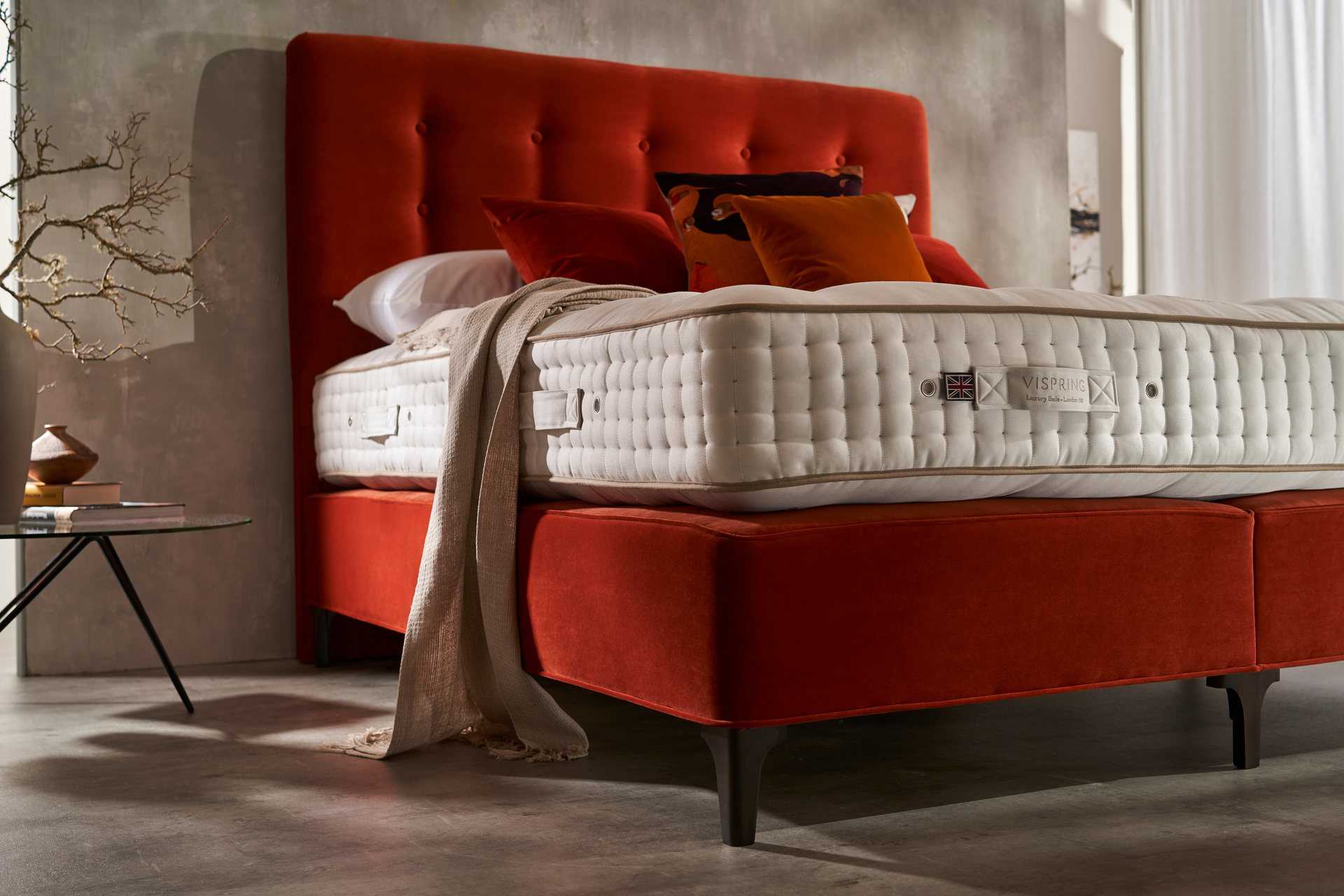
For an example of how an innerspring mattress can extend well beyond its coil core, consider the Vispring Signatory Superb. Its described construction combines two layers of hand-nested, vanadium steel calico pocket springs with a sequence of natural-fibre upholstery. The materials include British fleece wool, Austrian Moosburger horsetail, Shetland wool blended with cashmere, and a wool-and-organic-cotton layer. The ticking is described as a blend of wool, silk, and viscose.
This is a useful illustration of why “innerspring” does not necessarily mean a simple, exposed spring sensation. Coils form one part of a layered design; fibres above and around them shape the surface feel, breathability, and overall character. The Signatory Superb’s maker describes 3,296 pocket springs in a King size, with hand side-stitching along the border and hand-tufting through the mattress. Those details represent one particular approach to spring construction, not a standard shared by all innerspring mattresses.
When evaluating any model, compare its materials and assembly with your needs rather than using a premium example as a benchmark for the whole category. The right questions remain practical: how does it feel in your sleep position, what does its complete materials list contain, and does its construction suit the way you use your bed?
Durability and care: longevity is not a label
Mattress lifespan depends on the quality of materials, how the mattress is used, its foundation, and the care it receives. Latex is often chosen for its resilience, but longevity varies by formulation, layer thickness, and construction. Innerspring mattresses also differ widely: coil quality, upholstery materials, perimeter construction, and how evenly the mattress is supported all matter.
Before buying, review the manufacturer’s care instructions and warranty terms. Confirm whether the mattress can be rotated, whether it should never be flipped, and what type of base is required. A slatted foundation may need specific spacing between slats; an adjustable base may have its own compatibility requirements. Using an unsuitable foundation can affect comfort and may influence warranty coverage.
A breathable, washable mattress protector can help guard the sleep surface from spills and everyday wear, provided it does not make the bed feel uncomfortably warm or change its response. Keep the room aired, follow cleaning guidance, and avoid applying liquids or household products unless the manufacturer recommends them. Thoughtful maintenance is less glamorous than choosing a fabric or finish, but it is part of making a considered purchase last.
How to make a more personal comparison
Start by recording what your current mattress does well and where it falls short. Do you feel pressure at the hips or shoulders? Do you wake warm? Is it difficult to turn over? Does the bed feel too lively when a partner moves? Specific observations are more useful than a vague search for “comfort,” because they point toward features worth testing.
- Test your usual position. Lie on your side, back, or stomach as you actually sleep, and give the surface time to settle beneath you.
- Notice alignment and pressure. Look for a balance between cushioning and support rather than choosing firmness by reputation.
- Ask about the complete build. Request layer details, coil type, latex composition, cover materials, and any relevant certifications.
- Consider your sleep partner. Evaluate movement, edge stability, and whether each person experiences the surface differently.
- Read the trial and warranty terms. Understand the return window, required break-in period, fees, foundation rules, and exclusions before purchasing.
- Check the foundation. Confirm that your bed frame or adjustable base is compatible with the mattress you choose.
If you are comparing mattresses in person, spend more than a moment on each one. A showroom test cannot reproduce a full night, but it can reveal whether a surface feels immediately too firm, too yielding, or difficult to move on. If you are buying remotely, make the return policy part of the decision—not an afterthought.
So, which one belongs in your bedroom?
Natural latex may appeal if you want a buoyant, resilient surface with responsive cushioning and a less deeply enveloping feel. It is particularly worth exploring if ease of movement is high on your list, or if you are interested in a mattress whose composition can be specified in detail. Still, latex firmness, warmth, and pressure relief vary by model, so the label is only a beginning.
An innerspring mattress may suit you if you prefer a lifted, spring-led sensation, want to explore a wide spectrum of upholstery styles, or value the open structure of a coil core. It can be tailored with minimal or generous comfort layers, and its character depends on coil design as well as the materials around it. “Innerspring” is a family of constructions, not a single feel.
Neither is automatically superior, more supportive, cooler, or more durable. The best choice is the one whose surface, support system, materials, and practical terms align with your own requirements. A mattress should be judged as a complete object: not only by what it is made of, but by how those materials work together beneath you.
In the language of a well-considered bedroom, personalization is not an indulgence; it is the point. Begin with the way you sleep, investigate the construction with care, and let comfort—not category loyalty—make the final call.
Frequently asked questions
Is natural latex firmer than an innerspring mattress?
Not necessarily. Firmness depends on the specific model, its layers, and how it responds to the sleeper’s body. Both categories include a range of firmness levels, so compare individual mattresses rather than assuming one type is always firmer.
Do innerspring mattresses sleep cooler?
Coils create open space within a mattress, but the complete construction determines how the bed feels. Upholstery, covers, sheets, room conditions, and individual temperature preferences all contribute. Airflow through a coil core does not guarantee that every innerspring mattress will feel cool.
Are all natural latex mattresses organic?
No. “Natural latex” and “organic” are not interchangeable terms. Check which materials are certified, what the certification covers, and whether it applies to the latex, other components, or the finished mattress.
Can either mattress type work on an adjustable bed?
Compatibility depends on the mattress model and adjustable base. Verify the mattress maker’s guidance before pairing them, and check any foundation requirements or warranty conditions. Do not assume that every latex or innerspring mattress is designed to flex on an adjustable base.